
Why I need this nine-months habit-tracking experiment?
After all this tracking, all these graphs and diagrams, I found myself asking an interesting question.
There are many books and authors that talk about the same idea: start small, take small steps, do small things regularly every day, change your habits, and over time these small changes will lead to big amazing results.
So I started wondering: is it nonsense or not?
I don't mean than I can judge whether an author is right or wrong, does author right or wrong, or argue with him scientifically. It was just interesting for me to test it on myself.
What should I expect and what will I see if I take a long period of life and start to change small things in my life routine. Don't try to become a new person on Monday. Don't set twenty huge goals. Just get regular sleep, do morning exercises, go outside for some fresh air, take care of your diet, observe and reflect on your emotions, read, learn a language, and keep doing it month after month.
Will these small steps lead to serious changes after one year, two years, or several years? Or will I just say: "Oh, I was very disciplined about ticking boxes".
So that's why I need my habit tracker. I collect my data not for making tick or good percentage of habits, doing habits. I need statistics, I need data to review what happened, look back and compare different periods of my life - to see what improved or what got worse. To see my changes and try to understand what's going on with me and my system. That's why this habit project gradually become not just a habit tracker, but my own experiment.
Nine months is just another checkpoint.
What about my situation? Where am I after nine months?
This year I will continue watching F1 races. I often catch myself comparing my experiment to a Formula 1 season. There are cars (bolides) and teams which are outsiders at the beginning of the season. They don't have enough speed. The car often breaks down. The team makes mistakes. But the season is not short. The season is a long period. So the team will continue their work. They bring updates and make changes. If it works, they keep it. If it doesn't, they change it.
At the beginning of the season, the car was at the back of the field. By the middle of the season the same car might be fighting in the midfield.
That is exactly how I feel right now. In January my car was at the back of the field. I had problems with sleep, low energy, no proper system, and I was constantly overloaded with work and daily routine. There were a lot of things in the life which I want to do, but there was no space for them.
So after nine months I can say I am not the leader of the race, but I am not at that place which I was in January.
Now, I am somewhere in the midfield.
I feel more confident and focused. My attitude was stable towards my goals, achievement and results. I have started to understand my own limitations better. I see what works for me and what doesn't, where the problem is inside me and where it lies in the structure of the habit or the environment.
Over these nine months I have made many pit stops. Some habits dropped off, while some were modified. I combined several exercises into a single routine. In some areas I reduced the pressure. In others I changed the application's interface. And at some point I realized that the percentage of completed habits shows not the things which I saw before. But my car is running better. My car drives better.
Does it prove that nine months of small steps really work?
I can't say yes with 100% certainty.
I can't say that after nine months I've fully tested all the claims from these books on myself and can say now, "Yeah, that's proof. It works."
I can't separate the influence of my habits from everything else that happened in my life.
What happens after nine months? My life changed, my circumstances changed. There was new knowledge, a new project, new exercises, new interests and new experiences.
This is a one-person experiment.
That's why I can't honestly say that all these changes came from this set of habits.
But I can answer the following questions with confidence.
If I had done nothing for nine months, would I be in the same state that I am in now?
My answer is definitely not.
Most likely I would still be in the same state I was in January. Lacking sleep, lacking a system, having lower energy and feeling that work and routine took up all the space in my life.
And now, thanks to my notes and statistics, I don't just see percentages in a table. I see what I've accomplished.
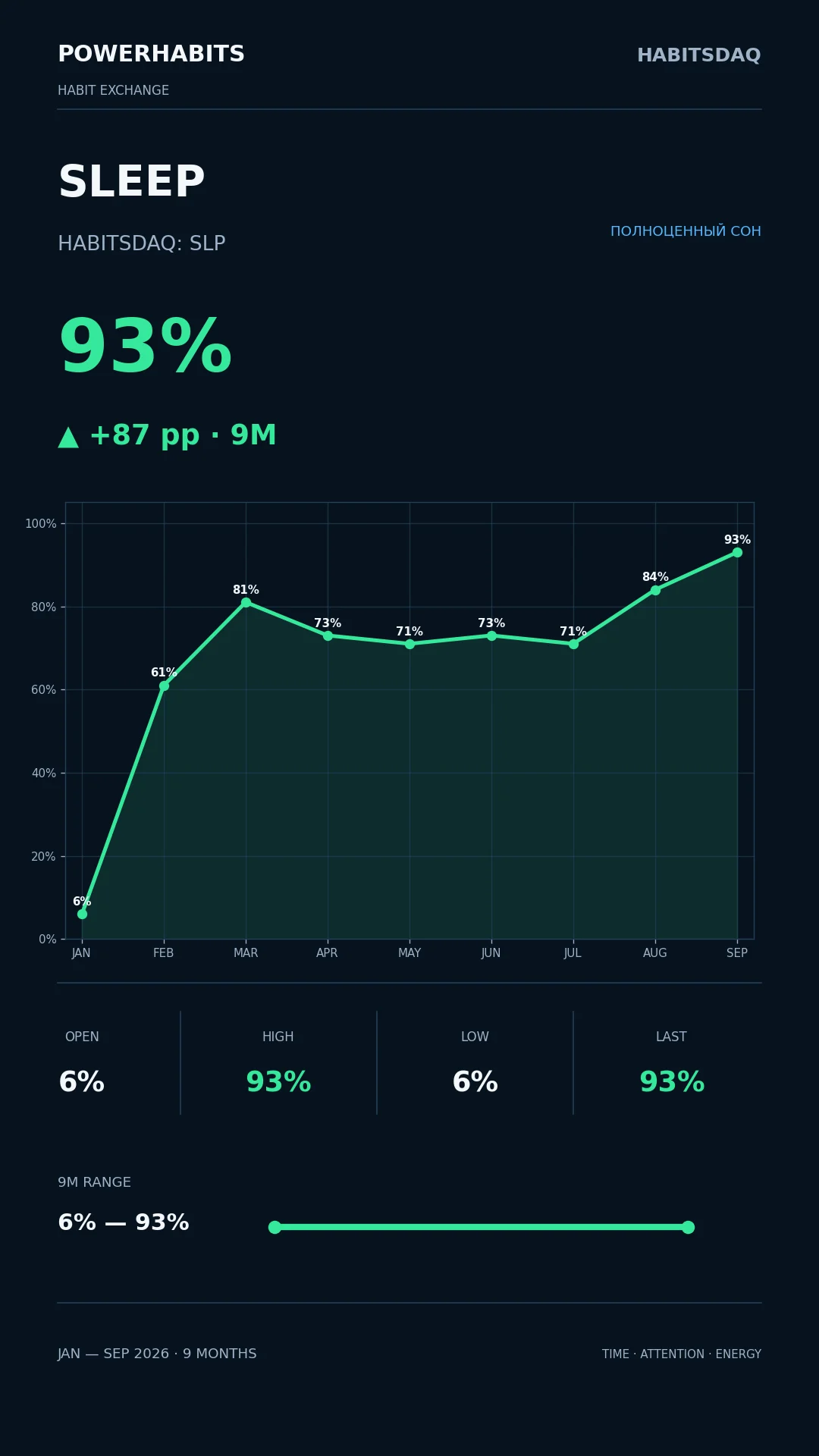
I can see how my sleep went from 6% to 93%.
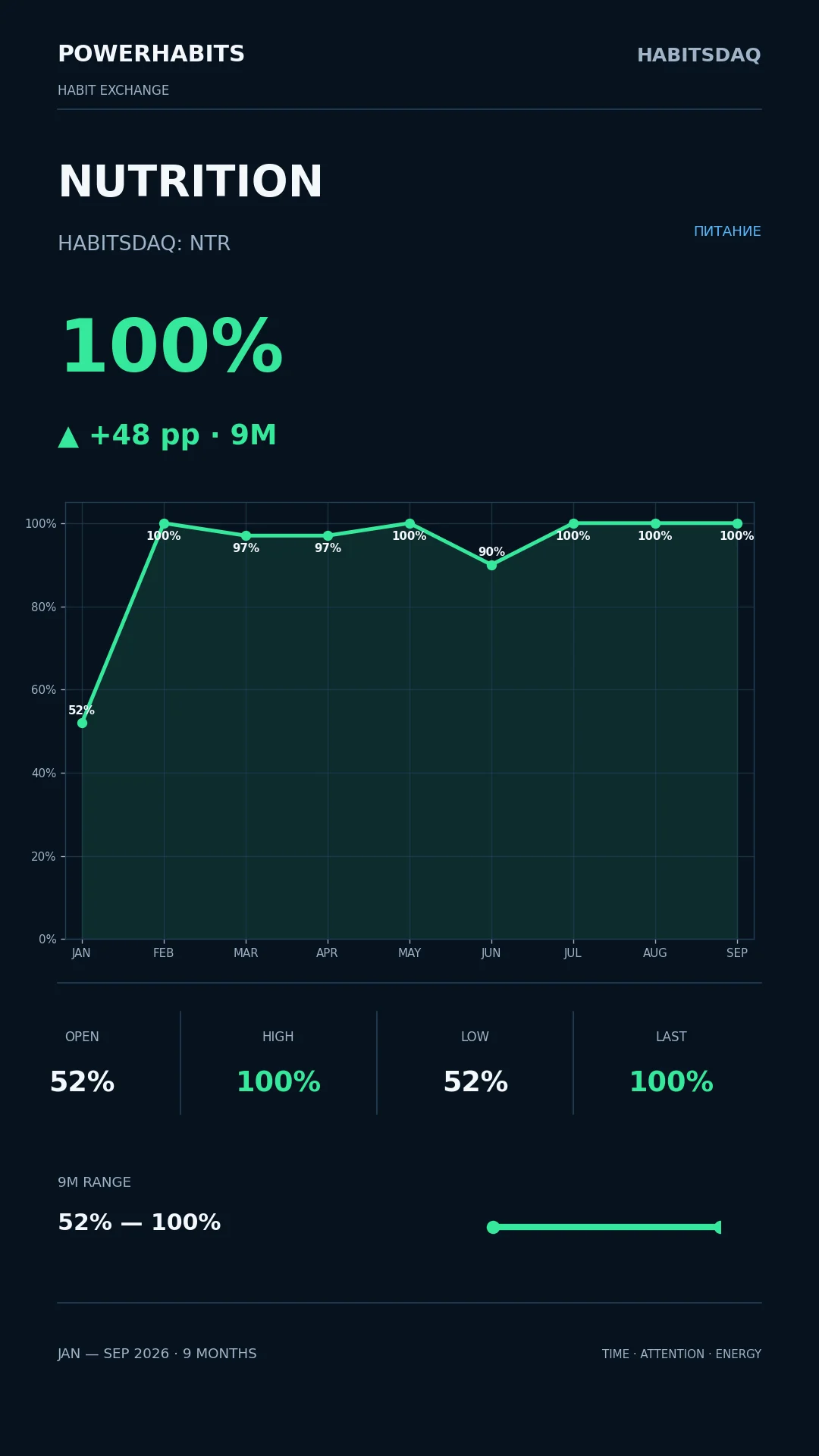
I can see my approach to nutrition, and now it hardly requires any conscious control because it's almost at 100%.
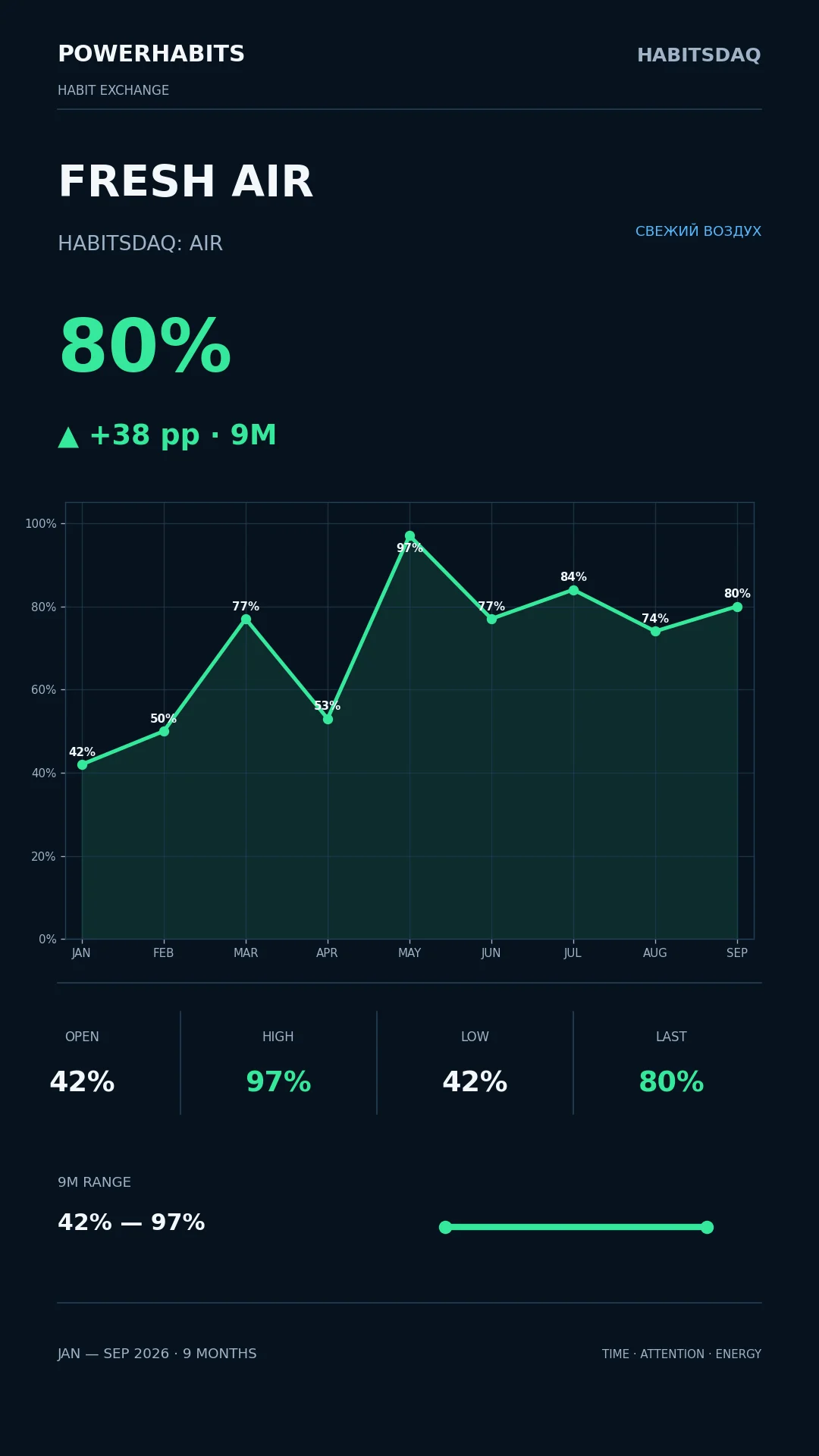
Fresh air and running have become a natural part of my life.
So I see more awareness in my reactions, and a physical training system adapted to my needs. A project that didn't exist at the beginning of the year, and a device which I started to develop to continue this experiment.
So my interim conclusion after nine months isn't that the theory of small steps has been proven.
But the result is: I don't know what big change will come with small steps after several years. But after nine months, I see enough to continue this experiment.
And the most important: my basic lifestyle has changed.
If I continue analogy with F1, the championship is not over yet. And the first nine months can't give the answer to the main question, but the car that started the season at the back of the field has now made it into the midfield.
So I am excited to see what happens in the future.
###Where is the money, Zin? Where is the money and why are these stock charts are here?
There is no money here.
These aren't stocks. These are my habits.
But over these nine months, I really did invest something: my time, my attention and my energy.
But where did I invest them? In sleep, nutrition, physical activity, fresh air, working on my reactions and mental state, reading, English and my project.
That's why it is interesting for me to look at the results as an investment portfolio.
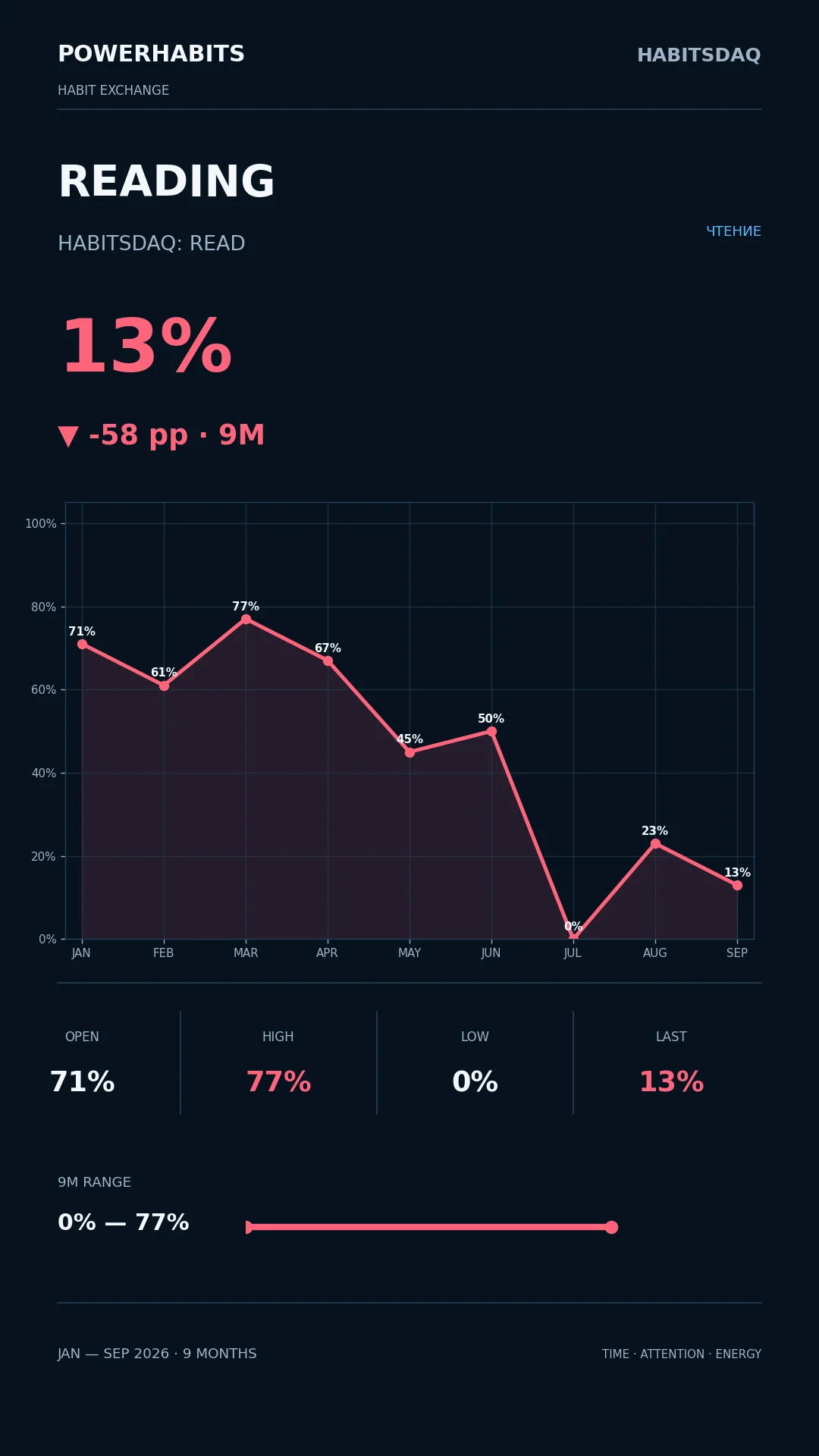
So every habit has its own ticker: SLP for sleep; NTR for nutrition; MMD for mental state; AIR for fresh air; WARM for morning exercise, warm-up; READ for reading.
Some assets grew over the nine months. Some remained stable. Some went into correction after a sharp rise. And several positions are still down.
Of course, it's just a way to visualize my statistics.
So growing from 9% to 93% doesn't mean a return on investment of 1500%. And a drop in reading from 71% to 13% doesn't mean that I lost 82% of my capital.
Something else is interesting here.
If we look at our time, attention and energy as limited capital, what have I invested them in over these nine months? And did it make me richer?
Next time I will continue this article, full report after nine months, explaining exactly what these graphics describe.