
Nine Months of Habit Tracking: The Report
It feels like the experiment started just yesterday, but here is my report after nine months.
1. It wasn't just individual habits that changed, but my overall lifestyle changed too
When I compare the key habits in January and September, I can see a clear difference.
Habit: January / September.
- Getting enough sleep: 6% / 93%.
- Nutrition: 52% / 100%.
- Mental state: 32% / 90%.
- Fresh air: 42% / 80%.
- Morning exercise: 35% / 73%.
- Tracking habits: 90% / 87%.
September wasn't an ideal month in terms of numbers. Reading dropped, some strength exercises weren't done regularly, new exercises routines appeared, and part of the system was reconstructed.
So the main outcome after nine months is that my achievement wasn't about checking more boxes, instead, my basic lifestyle changed. Sleep, nutrition, fresh air, emotion control, reactions control, physical activity and self-awareness now play a very different role in my life than they did in January.
2. Habits turned out to be different
After nine months I realized that the word "habit" covers very different states.
For example, the nutrition habit has become completely automatic. I only notice it when I've already eaten too much or feel that another couple of spoonfuls would be too much.
Next, fresh air and running work differently. I don't do them every day. If I have the opportunity, I just do it. I just go for a walk or a run. I don't have to argue with myself.
Next, the stairs. Taking the stairs has become a background habit. There is no special task for me to go upstairs every day on the sixth floor just to tick a box in the app. But I prefer taking the stairs to using the elevator if it's possible.
I'm keeping up my English in maintenance mode. I'd like to practice more, but for now I only have one lesson every Saturday
A completion rate alone isn't enough to describe the state of a habit
3. An automatic habit isn't necessarily invulnerable
The best example is my morning exercises.
Look at the completion rate from January to September: 35, 75, 97, 83, 100, 87, 77, 68, 73%.
By May, it had become almost automatic.
But then, I remember the thoughts appeared, like: "Why am I doing this? Nothing seems to be changing. What if I skip it?"
Those thoughts were enough to make even a very stable habit start to slip.
But after that, I changed my attitude towards it. I started viewing morning exercises as a way to maintain my body, joints, flexibility, and breathing.
I don't need to feel the physical effects every day to understand why these exercises matter.
This is one of the most important results of experiment: automation helps us avoid making the same decision every day, but it doesn't preserve the meaning behind the habit.
4. Maintaining a solid foundation matters more than growth
Sleep is a good example.
Look at the completion rate from January to September: 6, 61, 81, 73, 71, 73, 71, 84, 93%.
If we only look at the chart, we might call the period from April through July four months of stagnation.
It was a period of heavy workload, my daughter's hospitalization, changes to the habit system, new tasks, and a general feeling of being overwhelmed.
In that context, maintaining a sleep completion rate of around 70% looks very different.
Progress doesn't always mean a steady increase in percentages. Sometimes maintaining the same level for months during a difficult period is an achievement.
When things stabilized, the rate went up to 84% and then 93%.
5. Completion rate and actual progress are two different things
And pull-ups show this very clearly.
The completion rate from January to September were: 32, 25, 32, 37, 42, 27, 29, 23, and 23%.
Looking at the numbers alone, you can see a decline.
At the same time, I had more strength training: new sessions with trainer, and experiment with training load and recovery.
Pull-ups became a part of broader fitness system.
Only recently I have started to notice some progress in the number and quality of my pull-ups.
The frequency decreased, but my physical performance started to improve.
The completion rate measures how regularly you do an action, but it doesn't measure the result of this action.
6. The environment has also played an important role
Comparing pull-ups, planks and abs exercises makes this clear.
There is a pull-up bar at my office, outdoors and in other places where I can exercise. Sometimes I feel some resistance to getting started. But once I grab the bar, the question of whether to do it disappears.
It's different with planks. I don't want to do them in the office. It's not always convenient to do it outdoors, and I don't have enough time at home.
So the result is 0, 4, 19, 20, 26, 20, 19, 3, 0%.
Habit consistency depends not only on motivation.
I haven't lost the desire to do planks, but I don't always have a suitable opportunity.
7. Sometimes it's easier to redesign a habit than to force yourself to do it
It was the same with abs exercises: doing them separately takes time and requires a suitable place.
The solution wasn't about more discipline - it was a different approach.
I started doing leg raises on the pull-up bar between sets of pull-ups.
It's one of the most practical results of the experiment.
If a habit doesn't fit into your life, sometimes you need to change the habit, not the life.
Let's see whether abs exercises return to my statistics.
8. Sometimes a lower completion rate is the right outcome
Push-ups are another example.
Because of a shoulder problem, I don't do push-ups very often.
My goal isn't to get back to the old percentage at any cost.
I experimented with hand positions to find a way to do push-ups without shoulder pain.
And now I've found a way that works.
Trying to artificially increase the completion rate could be worse than keeping it low.
A 100% completion rate isn't a universal goal for a habit system.
The percentage only makes sense in the context of why you're doing it.
9. The statistics also reveal competition for limited resources
The clearest example is reading: 71, 61, 77, 67, 45, 50, 0, 23, 13%.
I haven't given up on reading. I still want to read. Reading is difficult because of my eyesight.
But I can use audiobooks. Audiobooks don't require my hands to be free, but they still require another scarce resource - attention.
My mind is occupied with work, the project, ideas and daily stuff.
This led me to an important observation: Having 30 minutes of free time doesn't mean having 30 minutes of mental space.
Over time, the statistics reveal not only which habits are stable, but also my actual priorities.
I'm trying something new: reading children's books to my kids. Maybe reading will return in a different form and become part of our family time.
10. Not every free moment needs to be optimized
I noticed this unexpectedly when I combined fresh air, running and morning exercise in the park.
I tried adding audiobooks to this routine so I could also check off my reading habit.
But then I realized that I didn't really want to do that.
Running and exercising outdoors give me a chance to spend 20–30 minutes without gadgets, information overload or extra tasks.
This is another result of the experiment.
It's not necessary to fill every free minute with another good habit.
Silence is also part of the recovery system.
11. Some habits work better in maintenance mode
A few words about English.
I'd like to improve my English more intensively, do homework more regularly, take extra lessons and perhaps translate my PowerHabits articles from Russian into English.
But I'm limited by time and my eyesight.
Still, I keep one English lesson every Saturday.
It's a middle ground between actively improving and giving up.
If you don't have enough time, energy or resources to develop a skill, a small but regular effort can help you maintain it for months.
12. The habit tracker itself became part of the experiment
Habit tracking remained stable over the last nine months.
The monthly completion rates were: 90, 100, 100, 90, 81, 83, 84, 97, 87%.
Sometimes I forgot to log my habits, but there was only one reason: I had no energy left in the evening. I'd get home and go straight to bed.
Only in the morning, I'd realize I hadn't marked my habits for yesterday.
At the same time, I can see how important the statistics are.
On the one hand, I need the data, but logging every habit in the app becomes tiresome.
On the other hand, I found a way to reduce resistance.
That led to the next stage of the project: PowerHabits Device.
A wearable tracker for the wrist or pocket, requiring minimal interaction and potentially collecting some data semi-automatically or automatically.
13. The same happened with my "Articles" habit
Its completion rates were: 30, 16, 20, 13, 10, 73.
The jump in September doesn't mean I wrote many more articles; rather, it means I did more work overall.
The name of this habit "Articles" is now outdated.
Now it really means working on the PowerHabits project as a whole.
The website was upgraded, and a more user-friendly admin interface was developed. It lets me publish articles on the go. In other words, I reduced the technical barrier to publishing.
At the same time, I started developing a device: researching and buying components, assembling them, and learning about electronics, physics, and new technical fields.
And again, the same pattern keeps appearing.
Sometimes activity increases not because your willpower has grown, but because you've reduced the friction between intention and action.
14. The system's architecture also changed over those nine months
In the beginning, there were pull-ups, abs, push-ups, plank, breathing, running, breathing, etc.
The longer the list became, the more the tracker got in the way of tracking.
That's why I introduced exercise routines such as strength, endurance, flexibility, and wushu technique.
Each routine contains a list of specific exercises.
You don't have to complete the entire routine in one session.
For example, I can do squats during my morning exercise and pull-ups later in the day.
A routine counts as completed if I've done enough of its exercises.
It was a shift from a checklist of actions to areas of life that I can support with suitable activities throughout the day.
I can't say yet whether the new architecture is better.
I've only just introduced it.
It's something to explore over the next few months of the experiment.
15. Another boundary has emerged: my own habits versus the product
I developed a short exercise routine for people with sedentary lifestyles.
Then I added this routine to the app.
I already do some of these exercises as part of my strength training and other workouts.
So I don't need to check off every exercise separately.
But I included them in the app for another reason.
When someone opens PowerHabits for the first time, the app can offer them a clear set of habits and exercises.
Otherwise, they might stare at an empty screen and wonder: "What should I do here?"
My thinking shifted from "What do I need?" and "How can I organize my system?" to "What would be useful to someone else?"
PowerHabits gradually grew beyond my personal habit tracker.
Conclusion
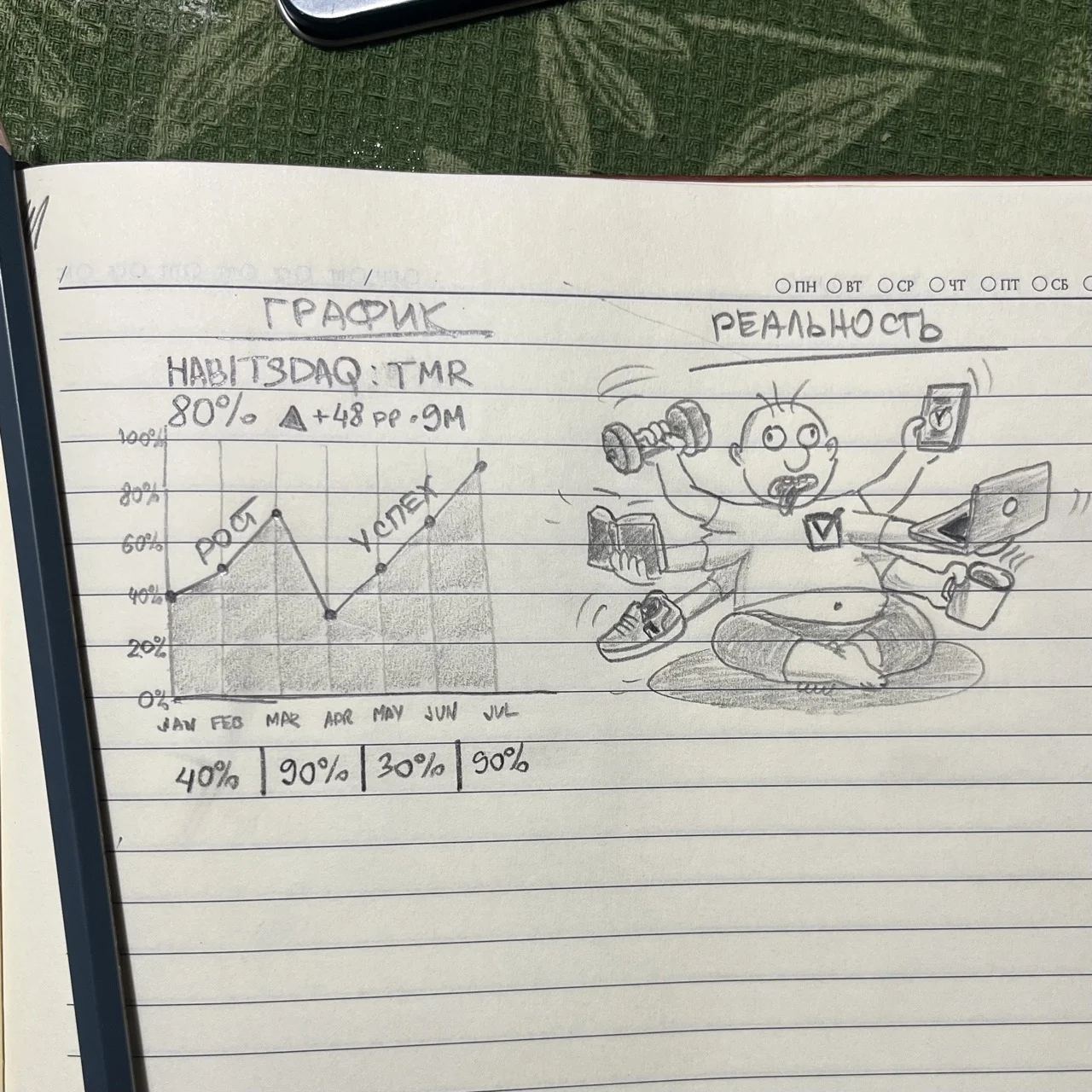
Looking back, the experiment has gone through several stages.
In January, I started recording many separate actions in my phone's notes every day
In the first few months, some habits improved quickly.
The first stable results appeared.
In spring and summer, real life tested the system: work, family, the hospital, stress, lack of time, and recovery. Some habits held up; others declined.
In summer, I realized that a long list of habits was becoming a problem in itself.
In August and September, I introduced new exercise routines.
The structure changed, and I continued improving the website.
By September, PowerHabits had become an almost daily project.
I started developing my own tracking device.
After nine months, the experiment was no longer just about checking off habits in my phone's notes.
Some habits became part of my everyday life.
Some revealed their limitations, while others had to be redesigned or grouped into routines.
And the tool I used to observe my habits gradually evolved into a project of its own.